

Sovereign AI
Starts With Power
Self-powered, modular AI Factories for customer-owned AI infrastructure.
By contacting us you agree to our Privacy Policy.
Sovereign AI Is Moving From Policy to Architecture
AI demand is growing faster than conventional data center capacity can be built. For many enterprises, institutions, governments, and regional operators, the bottleneck is not only access to AI models. It is usable infrastructure: powered, local, financeable, controllable, and deployable on a realistic timeline. The following three converging dependencies make sovereign infrastructure not optional but strategically mandatory.
HYPERSCALE DEPENDENCY
Enterprises and governments worldwide rely on a handful of foreign frontier providers. Every prompt and every dataset flows through their closed-box systems.
ENERGY CONSTRAINT
Traditional grids are at capacity. Sovereign AI requires private, off-grid power generation to bypass infrastructure delays and rising energy costs.
CAPACITY BOTTLENECK
Model access is becoming a commodity, but dedicated compute is not. Real sovereignty is only achieved by controlling the physical hardware layer.
CORE THESISSovereign AI starts with deployable power and compute. Real sovereignty is not only where the model runs — it is whether the infrastructure can be financed, deployed, powered, controlled, and upgraded by the customer.
The Sovereign Deployment Layer
A SOVPOWER AI Factory is a modular AI data center system that integrates compute, energy generation, cooling, and secure operation into one deployable system — operational within weeks, independent of the local grid.
Air-gap capability is an architectural option for institutions that need AI capacity inside their own legal, operational, and security perimeter.
SOVEREIGN COMPUTE
High-density compute clusters in standardized modules. No virtualization overhead — pure performance for AI training and inference. Fully operator-controlled to ensure data remains within the owner's legal perimeter.
SELF-POWERED OPERATION
Integrated on-site power generation creates a structural cost advantage and total energy independence. The facility operates without any connection to the local power grid, bypassing years of infrastructure delays.
MODULAR DEPLOYMENT
Standardized module footprint deployable on any industrial site within weeks. Scales linearly from a pilot unit to multi-rack regional clusters — without rebuilding infrastructure or modifying the site.
Module Architecture
Two standardized modules form one self-sufficient AI factory. On the
left, the Energy Module houses the gas generators and
battery system for fully independent power. On the right, the
Compute Module holds the AI cluster and its cooling.
Scroll to follow the energy flow — then click the four components to
explore how the system works.
The Architects

PHILIPP FEINDERT
German Diplom-Ingenieur in Electrical Engineering and Information Technology. Eight years at Mercedes-Benz Research, most recently in AI strategy and forecasting. Connects AI strategy, infrastructure architecture, and the energy systems required to make sovereign AI operational.
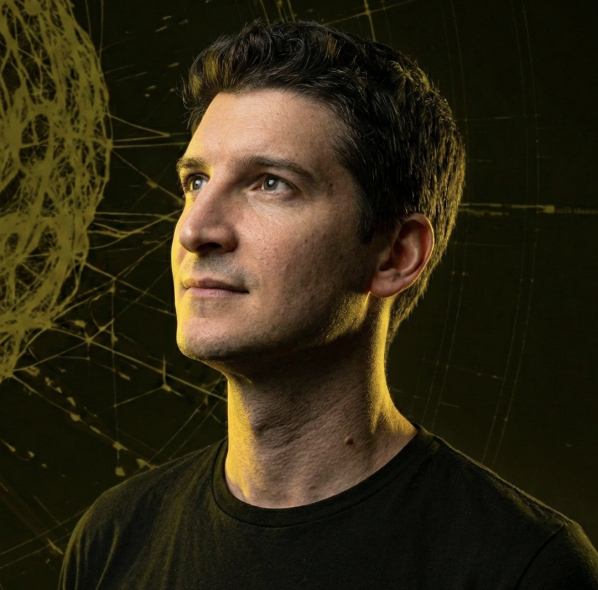
JAN JUNGE
German Diplom-Ingenieur in Electrical Engineering and Information Technology. Ten years at Mercedes-Benz, combining engineering depth with experience in technology transformation, AI-driven systems, and business strategy. He leads the company with a focus on innovation and helping organizations turn artificial intelligence into real business value.
Explore Sovereign AI Deployment
Speak with us about self-powered AI infrastructure for public-sector, industrial, education, and regional compute use cases.
By contacting us you agree to our Privacy Policy.